• Skip to main content

Lisa Finks, Compass Real Estate

Lisa Finks, Lourdes Arencibia and Carolyn Duris, REALTORS on Chicago's North Shore.

Lisa Finks

Price Distribution in North Shore Chicago Real Estate

November 13, 2019 by Lisa Finks Leave a Comment

You’ve heard the old adage to never buy the most expensive home on the block, the same can hold true for your town as well!  Of course, sometimes you want that special home and can only get the yard you desire by purchasing at the upper end in a certain area (think Northfield and Glenview) so the purchase makes sense for you. Check out the price distribution charts for various North Shore towns and north side zip codes – see where your home fits in!


Price distribution North Shore and Chicago real estate

Price distribution North Shore and Chicago real estate

Filed Under: Home Values, Market Stats, Uncategorized

Heirloom Homes – Saving It For Your Family

November 9, 2019 by Lisa Finks Leave a Comment

Reprinted from the Wall Street Journal

Heirloom Homes – Saving It for your Family

Passing down a family home can be wonderful but can also be rife with family problems if not well planned

lake home

This four-bedroom house in East Lyme, Conn., was built by Elisha Cooper’s great-grandfather in 1913. JULIE BIDWELL FOR THE WALL STREET JOURNAL

By Amy Gamerman

Jeremy Wolff, a photographer based in upstate New York, is part owner of a six-bedroom beach house near Hyannis on Cape Cod in Massachusetts that has been in his family since the 1940s. His co-owners? Nearly 30 relatives, including eight cousins and their families, who book their visits on a family website.

“There’s sometimes some tension—like, ‘You always get the upstairs front bedroom’—little squabbly things like that,” Mr. Wolff said.

The joy of having an heirloom vacation home in the family sometimes comes with a side order of angst: costly upkeep, perpetual repairs and ancient yet enduring sibling rivalries. A legacy lake house or mountain lodge may be shared by scads of siblings and cousins, who have to figure out how to divvy up prime vacation weeks and holidays, to say nothing of property taxes and maintenance responsibilities. Basic decisions—like reupholstering Grandma’s sofa—are anything but basic when a dozen or more relatives have to sign off.

lake home

The living room of the East Lyme cottage, partly owned by Elisha Cooper, is lined with pictures, family mementos and books. PHOTO: JULIE BIDWELL FOR THE WALL STREET JOURNAL

“The process of the family deciding and agreeing on replacing the fabric literally took five years,” said Mr. Wolff.

Elisha Cooper, an author whose children’s book “River” was just published, owns one-sixth of a 2,000-square-foot, four-bedroom cottage with a wraparound porch on Black Point in East Lyme, Conn., that his great-grandfather built in 1913.

“It’s basically a porch with a cottage attached,” said Mr. Cooper, 48, who lives with his wife and two daughters in New York City. The house, which was placed in a family trust in the mid-1990s, is shared by three branches of his extended family, in New York, Massachusetts and London. “I split my branch’s share with my brother,” said Mr. Cooper, adding, “at some point, we’re each going to own a toilet.”

lake home

Mr. Cooper owns approximately one-sixth of the cottage. PHOTO: JULIE BIDWELL FOR THE WALL STREET JOURNAL

The uninsulated cottage occupies a prime 1.3-acre spot on a grassy hill overlooking the salt marsh and ocean. In 2016, the town assessor appraised its value as $945,000. Mr. Cooper’s share of taxes and insurance comes to several thousand dollars a year. This year, it is his turn as manager of the Black Point property, which involves overseeing its maintenance and the schedule: each branch gets 42 prime spring, summer and fall days, to be meted out among its individual members (the home is boarded up for the winter). Major holidays are divvied up, “so if somebody takes Labor Day, someone else is going to take July 4th,” Mr. Cooper said.

There are pitfalls to sharing an heirloom home that happens to be full of heirlooms. “My cat got obsessed with this old wooden model boat and knocked it off the piano—that was a family drama,” Mr. Cooper recalled. “I had to spend $3,000 to re-rig and fix the boat because it was an antique.” Some of his relatives prefer a more low-tech approach to home repairs: “There’s a broken chair and it’s just left with some tape on it—or twine, done in a nice bow.”

Family summits take place on Memorial and Labor Day weekends.

“We all gather—my aunt flies in from London—and we sit on the porch and we talk. These are big decisions, like ‘Do we cut the field?’ and ‘How is that going to affect the monarch butterfly migration?’ ” Mr. Cooper said. “We never argue, that’s because we are New Englanders. We silently and very politely disagree.”

lake home

Schuyler Grant’s cottage on Long Island Sound in Fenwick, Conn., built in 1868, has been in her family for three generations. JULIE BIDWELL FOR THE WALL STREET JOURNAL

Some farsighted matriarchs and patriarchs endow trusts so that legacy properties will stay in the family with minimal discord or generational financial strain. Gerry and Del Carrier, who own a 5,000-square-foot mountain ski home in New Hampshire’s White Mountains, created a trust in 2013 so that their five children, nine grandchildren and three great-grandchildren can enjoy the house “in perpetuity,” in Mr. Carrier’s words.

“We estimated taxes, we estimated the maintenance—we are leaving them with very adequate financing so that it will not be a burden,” said Mr. Carrier, 84, a retired dentist who owns a second home in Vero Beach, Fla.

Mr. and Mrs. Carrier, who is 83, acquired the half-acre lot with views of Mount Washington for $1,500 in 1968, building a modest three-bedroom home where they brought their children every weekend. In 2005, they embarked on a $750,000 remodel and expansion, adding a wraparound porch, a dining room spacious enough for 25, a large bunkroom for the grandchildren and a bedroom suite for each of their children—a critical element for maintaining family harmony. There are seven bedrooms in all. At the time they established the trust, the house was appraised at $1.2 million, Mr. Carrier said.

lake home

Jeff Krasno and Schuyler Grant on the steps of their Fenwick home with their children, Phoebe, 15, Ondine, 12 and Micah, 9. PHOTO: JULIE BIDWELL FOR THE WALL STREET JOURNAL

His children and grandchildren use the house throughout the year, coming for the fall foliage, skiing in the winter, hiking and kayaking in the summer. The entire clan gathers there every Christmas.

“For as long as I can remember, every Friday night my father piled his five children into a station wagon to go to a retreat where we could just bind together as a family,” said Michelle Carrier-Trial, 59, a lawyer based in southeastern Massachusetts. She and her younger brother are the home’s two trustees: ultimately, each of the siblings will own an equal share in the house. “After my parents are gone, we hope to keep it the same way for our children,” she said.

Sometimes, however, a beloved home can become an albatross for the current generation. As a child, Schuyler Grant spent every summer at her grandparents’ seaside vacation home—just down the beach from her great-aunt Katharine Hepburn—in the Connecticut borough of Fenwick, an enclave of grand Victorian-era cottages on Long Island Sound. Built in 1868, the six-bedroom shingled house has a deep porch, its own pebbly beach and four generations of Grant and Hepburn family history.

“Every time I would come through the door, I was bathed in this smell of the house—it was like a portal to this whole other world of tennis lessons and duck belts,” said Ms. Grant, who lives with her husband and three daughters in Los Angeles. “It was extremely buttoned up—I used to have to dress for drinks every night in Laura Ashley smocks.”

Ms. Grant, 49, founder of Kula Yoga Project, in New York, and her husband Jeff Krasno, 48, founder of Commune, an online learning platform, bought the 5,400-square-foot Fenwick home in 2009 from her aunt, the actress Katharine Houghton, for $1.8 million, public records show. Their family shares the house with Mr. Krasno’s father and stepmother, Richard and Carin Krasno, who contribute toward the costs of maintaining the property and who visit every August and September from their home in Coral Gables, Fla.

lake home

Three generations of the Carrier family use the house throughout the year. PHOTO: RACHEL SIEBEN FOR THE WALL STREET JOURNAL

“Everybody has to be their highest self—it can get really difficult,” Ms. Grant said of the dynamics. Plus: “There’s always one leak in the house that they haven’t been able to fix in 160 years, so it comes with a certain amount of buckets.”

The family spends nearly $50,000 annually in property taxes, including a Fenwick borough tax. Standard maintenance and upkeep adds another $27,000 every year. That doesn’t include the cost of reshingling the house or replacing its rattling, circa-1970s windows; the latter cost about $100,000. Ms. Grant, who offsets these expenses by renting out the house for part of the summer, reluctantly put it on the market for $3.375 million last year.

“The expense is so great, the emotional and financial upkeep is so massive, that if you are not really there then it’s so hard to justify,” said Ms. Grant. “Our dream is that we find this awesome family that wants to buy the house, but they are a little cash-strapped and have to rent it back to us in August.”

Tips For Keeping Grandma’s House
In The Family

1. Make sure your descendants actually want the house. “It’s common sense: the heirs don’t always have the same values,” said Jonathan Miller, president of Miller Samuel Real Estate Appraisers and Consultants. He advises clients “to really survey their family and have a talk about it—the children should be an active part of the planning.”

2. To head off family feuds, spats over remodeling, prime holidays, or a push to sell, transfer ownership of the house to a limited liability company, with a user agreement that sets out terms and conditions. Or create a trust for the property with its own bylaws. That way, Grandma can make sure that everyone plays by her rules for the cottage long after she’s gone.

3. That roof is going to spring a leak sooner or later. Create a dedicated fund for maintenance, taxes and other costs, supported by annual contributions from family members. Note: If you break a lamp or a doorknob comes off in your hand, fix it yourself or prepare for frost at the Labor Day clambake.

4. Have an exit strategy. Any long-term plan should factor in the possibility that descendants may need to sell. Outline provisions for doing so. “Personal situations are going to change,” said Mr. Miller. “Many of these owners are between a rock and a hard place, trapped between nostalgia and hard economic reality.”

5. Remember: It’s just a house. “It’s really more about the family itself than the real estate,” Mr. Miller said. “Those Thanksgiving meals and family get-togethers were special because of the occupants of the house—not the house itself.”


Filed Under: Home Finance, North Shore Lifestyle, Real Estate Tips

Six Must-Haves Needed to Seduce Buyers

October 20, 2019 by Lisa Finks

Always fascinating to see the latest trends out of NYC luxury real estate. If you are looking for new construction in Wilmette or on the North Shore, we have a list of local resources and trends found here.
Front & York in Brooklyn has installed chevron floors, smart-tech thermostats and lots of marble in its Dumbo sales office.
Front & York in Brooklyn has installed chevron floors, smart-tech thermostats and lots of marble in its Dumbo sales office.CreditCreditStefano Ukmar for The New York Times

The High End

A look at the appliances and finishes that developers say will make their new high-style condos stand out from the high-style competition.

Developers have long worked with architects on their luxury buildings, but some years ago they also began hiring top-flight designers to give the interiors the same panache as the exteriors.

Having the likes of Paris Forino, Ryan Korban or Lee Mindel associated with a building became yet another way to brand it as special — and worthy of prices that today can run more than $2,400 a square foot, compared to the norm of $1,500 a square foot, according to a recent Douglas Elliman report.

But while developers hire designers to add a signature style to differentiate their buildings from the competition, it doesn’t always work out that way: The apartments end up having quite a lot in common with others in the same market niche.

“Everybody’s looking at what everybody else is doing,” said Jonathan Miller, the president of Miller Samuel Real Estate Appraisers & Consultants, comparing the phenomenon to the so-called amenities war in which projects try to match one another in the number and lavishness of common spaces. Similarly, an apartment can be “really nice and special and unique — and not dissimilar to the other five places you just looked at,” Mr. Miller said.

So how do you distinguish a high-end apartment from a standard-issue one? Here are some of the materials and finishes — trending, but not always new — that developers are hoping will attract affluent buyers.

Herringbone or Chevron Patterns

Remember dark-stained floors? Today, high-end apartments are more likely to have white oak underfoot — particularly European or French white oak from trees that, yes, grow in France — though it’s probably not solid oak but rather an engineered product with the wood veneer on top.

Often the planks of wood are not lined up next to one another in staggered parallel lines, but laid out in zigzag patterns known as chevron and herringbone.

ImageA marble floor was laid in a chevron pattern at Front & York in Dumbo.
A marble floor was laid in a chevron pattern at Front & York in Dumbo.CreditStefano Ukmar for The New York Times

Although the patterns are slightly different — with chevron, the planks of wood have diagonal, or mitered, ends so as to create a series of neat, arrow-like points, whereas with herringbone the ends are cut at a right angle, for a woven effect — the overall look is similar. The technique can also be used with other flooring materials, including marble, and sometimes appears in bathrooms.

Such floors do require more time and expertise to install, and have a whiff of the intricate parquet that designers sometimes specify for one-off interiors for individual clients. But they can be achievable even when you’re “doing the floors of 100 units in a building,” said Ms. Forino, who selected chevron for the 53-unit 359 Second Avenue, which recently broke ground in Manhattan’s Gramercy neighborhood.

Other designers stick with the standard layout but specify extra-wide wood planks for an industrial-chic look. Whereas planks in most new developments today are three-and-a-quarter inches wide, said Joel Lefkowitz, the executive vice president of Wood Manners, a Spanish-based flooring company, the Daniel Romualdez-designed apartments in 70 Vestry, in TriBeCa, have planks that are seven-and-a-half inches wide. At 111 Leroy, in the West Village, the oak planks are nine inches wide.

Whichever flooring pattern or plank width chosen, the finish of choice is matte, usually achieved with low-gloss polyurethane. “Shiny looks fake,” Mr. Lefkowitz said.

Marble Is Everywhere

The man-made stone — like Caesarstone, Corian and so-called quartz — specified in more moderately priced interiors is certainly durable, but high-end homes are done up in marble. At 40 Bleecker, in NoHo, Mr. Korban employed marble for two-tiered kitchen counters and used “book-matched” pieces (mirror-image slabs laid side by side) on stove hoods, an appliance more commonly associated with utilitarian stainless steel. In bathrooms, marble can appear on practically every surface.

Calacatta, a gray-veined marble quarried in Carrara, Italy, remains the go-to choice. Bianco Dolomiti has its followers, too. “We like it because it is subtle,” said David Mann, the founder of MR Architecture & Décor, who designed the interiors of 111 Murray, in TriBeCa.

As with floors, the highly polished stone of yesteryear has, well, lost its shine. Increasingly, marble is “honed,” which has a soft sheen and is “less showy,” said Nancy Piraquive, a broker at Brown Harris Stevens and former interior designer.

Kitchen Appliances Abound

High-end buildings are piling on warming drawers, built-in coffee machines, double dishwashers, wine refrigerators and more.

Appliances made in America? Not so much. Subzero refrigerators — the status brand from the last development cycle — still make an appearance, as do Viking and Wolf stoves. But today you are more likely to find European brands like Miele, Bosch and Lacanche — with Gaggenau being “the crème de la crème,” said Whitney Kraus, director of architecture and planning for Halstead Development Marketing.

Ms. Kraus said the European brands have a reputation for possessing a “sleeker aesthetic” and being “more high-tech.”

Snob appeal might be involved, too. “There’s something exotic about having a brand that most people haven’t heard of,” Mr. Miller said. “It sounds fancy.”

Mrs. Piraquive of Brown Harris Stevens sees a more sobering reality: Many new developments were designed with international buyers in mind, she said, and these are the brands they know. “Unfortunately,” she added, “those buyers are gone.”

Soaring Ceilings

New York’s prewar buildings typically have nine-and-a-half-foot ceilings. In the postwar era, ceilings dropped to eight-and-half feet. In later years, they began to inch back up in luxury buildings, to nine feet.

Today, 10 is the new nine, and some ceilings are higher. Madison House, the tallest building in NoMad, has ceilings that reach 11 feet in the apartments, which have been designed by Gachot.

High ceilings nibble into a developer’s profits because fewer floors — hence units — can fit in their buildings.

Can a ceiling be too high? Ms. Kraus of Halstead thinks so. Ceilings of 10 to 12 feet make for rooms that are “gracious,” she said. “Beyond that, it’s a waste for everybody.”

An Art Wall

This feature may reflect the emphasis that luxury buildings are placing on art — a major piece of sculpture often installed outside the main entrance or in the lobby — and is based on the assumption that buyers who can afford an apartment in the multiple millions surely also collect paintings and photographs.

The problem has been that many new developments are glassy, offering floor-to-ceiling windows, yes, but leaving precious little wall space for hanging art. Enter the marketing geniuses, who once repackaged slop sinks in basement closets as “pet spas” and have now anointed a swath of unused wall somewhere in an apartment an “art wall” or “gallery.”

“Aren’t we nice?” quipped Mr. Miller. “We gave you a blank wall.”

Smart Tech

When luxury condos cost as much as they do today, the ability to set the temperature of your New York apartment via phone while vacationing on the other side of the globe is a requirement. No need to manually operate curtains or lighting, either.

The marketing team for the Centrale, in East Midtown, a Ceruzzi Properties project with interiors by Champalimaud Design, recommended Nest Learning thermostats for the apartments, said Tariq Mahmood, director of construction for Ceruzzi’s New York division. The devices have occupancy sensors and will turn the heat or air-conditioning on or off based on whether someone is in the room.

“It doesn’t make sense to have manually operated thermostats anymore,” Mr. Mahmood said.

Bathroom Floors Are Toasty

The master bathroom often has radiant heating, and at Parlour, on Fourth Avenue in Park Slope, it’s in the “secondary” bath, too. In the powder room, however, you’re on your own.

For weekly email updates on residential real estate news, sign up here. Follow us on Twitter: @nytrealestate.

Correction : Oct. 18, 2019

In an earlier version of this story the surname of an interior designer was misspelled. He is Ryan Korban, not Korbin.

A version of this article appears in print on , Section RE , Page 12 of the New York edition with the headline: High-Style Touches Selected for Choosy Buyers. Order Reprints | Today’s Paper | Subscribe


Source: Six Must-Haves Needed to Seduce Buyers

Filed Under: Home Decor & Garden

Home Equity and College Aid

October 14, 2019 by Lisa Finks Leave a Comment

Reprinted from the Wall Street Journal

How Home Equity Affects College Aid

The rules vary dramatically between schools on how much of your home equity will be used to calculate an aid package

By

Beth DeCarbo

Updated Oct. 3, 2019 2:52 pm ET

Fall is hunting season across the U.S., a time when high-school seniors target their favorite colleges and their parents aim for financial aid.

One factor to consider when applying: the impact of your home’s equity on financial aid. But prepare yourself. It seemingly takes an advanced degree to calculate eligibility, since formulas vary widely from school to school.

“I wish it weren’t so complicated. I study this day and night,” says Paula Bishop, a college financial-aid adviser in Bellevue, Wash.

Almost all U.S. colleges and universities require financial-aid applicants to fill out the Free Application for Federal Student Aid (FAFSA), which doesn’t ask parents about home equity. However, several hundred schools—many of them elite, private institutions—also require the College Scholarship Service Profile (or CSS Profile), an application created by the College Board for nonfederal financial aid. It asks applicants for the home’s purchase price, purchase year, current value and current debt and determines the home’s equity (value minus debt).

Here’s the catch: Schools that require the CSS Profile handle the home-equity information differently. Boston College, for example, looks at 100% of home equity. Stanford University announced last year that it won’t consider home equity at all. Cornell University will limit home equity to 1½-times the family’s adjusted gross income. So for a household with $800,000 in home equity making $200,000 a year, home equity is capped at $300,000 (200,000 x 1.5).

Bucknell University caps home equity calculations at two times a family’s adjusted gross income. PHOTO: EMILY PAINE/BUCKNELL UNIVERSITY

The school isn’t necessarily expecting parents to tap their home equity to cover their child’s tuition. Instead, the school considers home equity and other assets to determine how much parents can contribute toward college costs. The higher the assets, the more parents are expected to pay. Generally, the parental contribution is calculated at 5% of assets. At Cornell, the family with $300,000 in home equity will be expected to lay out $16,500 a year. Had the “true” home equity of $800,000 been used, the parents would be expected to cover $44,000 in costs a year.

This formula is actually more complex than I describe because schools consider other assets—not just real estate—and a number of other variables, such as the number of siblings attending college simultaneously.

But the bottom line is that the school’s home-equity formula can have an enormous impact on what parents pay—something Ms. Bishop, the financial-aid adviser, learned firsthand. In 2010, her son applied to American University in Washington, D.C., a school that uses the CSS Profile. At the time, her home equity was $700,000, even though the house had been purchased for $400,000. American says that, as a starting point, its policy is to assess 100% of home equity. Ms. Bishop says she initially received an aid package below what she expected. She appealed to the financial-aid office, arguing that her husband wasn’t working at the time and that increased home values in her area skewed the calculations of her ability to pay the parental contribution. As a result, the school agreed to cap her home’s value at two times her household earnings. Using the lower home equity resulted in an extra $6,000 in financial aid.

The University of Virginia, Charlottesville, Va., does not take home equity into account when computing financial aid for students. PHOTO: UNIVERSITY OF VIRGINIA

Real-estate holdings can affect financial-aid applications in other ways. First, unlike a primary residence, vacation homes are counted as an asset reported in both the FAFSA and CSS Profile applications. The same goes for rental properties—even if it is an apartment inside the family home leased to a nonfamily member.

If an investment property or second home is sold before applying for financial aid, the capital gains may be considered an asset if reported on a tax return and counted as income.

Also, when borrowing against your home, avoid a home-equity loan because the unspent proceeds are counted as an asset, says Julie Gross, a vice president with College Financial Consultants in Livingston, N.J. Instead, she recommends a home-equity line of credit (HELOC), which is the ability to borrow against your home.

A HELOC may also be a smart option for parents who need financing for their child’s education. Currently, HELOC rates are about 5.5% with no or low application fees, according to Bankrate.com.

By comparison, a college PLUS loan, which is a federal loan offered to parents for education expenses, charges about 7% to 8% interest with application fees up to 4% of the total loan.

If parents need to pay down credit cards or make home improvements, a HELOC actually improves their chances of getting financial aid because the line of credit lowers their home equity.

Tips For Applicants

Get the formula: Call the school’s financial-aid office and ask how it calculates home equity. Policies change, so confirm the formula early in the process.

Get an estimate: For a rough estimate of college costs, use the Net Price Calculator on schools’ websites.

Don’t overinflate home value: A high estimate can hurt your chances of qualifying for aid. Use home values based on comparable—and current—real-estate listings in your neighborhood.

Appeal the decision: Contact the financial-aid office and ask if there is a form or process for appeals. Generally, you write a letter explaining your circumstances—a job loss or medical condition—that underscore the need for more aid.

Corrections & Amplifications
Julie Gross is a college-aid adviser in Livingston, N.J. An earlier version of this article incorrectly called the city Livingstone. In the chart, Bucknell University is located in Lewisburg, Pa., not Lewiston, Pa., and Lewis & Clark College caps home equity at 2-times adjusted gross income, not 2.4 times adjusted-gross income. (10/3/19 and 10/8/19)


Filed Under: Home Values

It’s the Black Friday of Real Estate! Or is it?

September 24, 2019 by Lisa Finks Leave a Comment

So it’s the Black Friday of Real Estate this week!!

It's the Black Friday of Real Estate!

It’s the Black Friday of Real Estate!

Have you heard? You can see the national stats in the article. Here are our New Trier Township stats:

May 2019 = 618 homes on market v. Sept 2019 = 514 homes on market. 17% decline in inventory.

May 17-24, 2019 = 451 showings v. Sept 17-24 = 333 showings. 26% decline in showings

May 2019 = 110 under contract’s v. Aug 2019 = 78 Under contract’s. 30% decline in UC activity.

Lots of great homes still on the market and motivated sellers! Give us a call to check out your favorites!

It’s Real Estate Black Friday this week.

Filed Under: Uncategorized

North Shore Halloween Fun for Kids – 2019

September 23, 2019 by Lisa Finks Leave a Comment

The Ultimate Guide to North Shore

Halloween Fun for Kids!

Friday, October 18, 5:30 – 8pm, Halloween Spooktacular,(Kid friendly), 2400 Chestnut Ave, Glenview

Saturday, October 19, 4 – 8pm – Halloween Happenings (Kid friendly), Wilmette Park District

Friday, October 18, 4 – 6pm, Pumpkins in the Woods, (Kid friendly), Tower Road Beach, Winnetka

Saturday, October 26, 1 – 2:30pm – Spooky Skate (Kid friendly), Wilmette’s Centennial Ice Rink

Saturday, October 19, 6 – 9:30pm, Haunted Trail (age 10 & up – scary), Lloyd Beach, Winnetka

Saturday, October 26, 10 – 1pm Evanston Trick or Treat Trot, (Kid friendly), Charles Gates Dawes House, 225 Greenwood, Evanston

Thursday, October 31, 1 – 2pm, The Big Halloween Balloon Show, (Kid friendly) Winnetka Community House

Saturday, October 26, 3 – 6pm, Boo Bash, (Kid friendly) The Glen Town Center, Glenview

Saturday, 10/19 and 10/26, 12 – 1:30pm, Scream Scene – Lights On, (Kid friendly) 4701 Oakton Street, Skokie

Saturday, November 2, 5:15 – 8pm  Zombie Scramble, (Kid friendly) Ladd Arboretum, Evanston

Filed Under: Fun Events, North Shore Lifestyle, Odds & Ends Tagged With: halloween, Kids, North Shore

Top 10 Scariest Chicago Haunted Houses

September 23, 2019 by Lisa Finks Leave a Comment

Top 10 Scariest Chicago Haunted Houses

Top 10 Scariest Chicago Haunted Houses

Your ultimate guide to the Scariest Chicago Haunted Houses!

Feeling brave?

Chills and thrills for all this Halloween with this Top 10 list of Chicago’s Haunted Houses.

Visit one or all, if you dare. . .

  1. Scream Scene | 4701 Oakton St., Skokie | 10/24/19 – 10/27/19
  2. Fright Fest | Great America, One Great America Pkwy, Gurnee | 9/14/19 – 11/3/19

  3. Dungeon of Doom | 600 29th St., Zion | 9/27/19 – 11/9/19
  4. 13th Floor | 1940 George St., Melrose Park | 9/27/19 – 11/9/19
  5. Statesville Haunted Prison | 17250 S Weber Rd., Lockport | 10/3/19 – 11/2/19
  6. Midnight Terror | 5520 W 111th St., Oak Lawn | 9/27/-19 – 11/2/19
  7. Insanity Haunted House | 3940 IL-251, Peru| 10/4/19 – 11/2/19
  8. Hell’s Gate | Lockport Metra Lot, 1300 South State St., Lockport | 10/3/19 – 11/2/19
  9. Basement of the Dead | 42 W New York St., Aurora | 9/27/19 – 11/2/19
  10. The Massacre | 299 Montgomery Rd., Montgomery | 9/28/19 – 11/2/19

Filed Under: Fun Events Tagged With: halloween, haunted house

Compass Concierge on Chicago’s North Shore

August 30, 2019 by Lisa Finks Leave a Comment

Now available on Chicago’s North Shore! Get funding to front the costs for improvements that increase the value of your home!

Lisa Finks & Lourdes Arencibia are your Compass Concierge experts for Chicago's North Shore. We will ensure you make smart improvements in the most economical way to increase the value of your home on Chicago's North Shore.

Lisa & Lourdes are pleased to bring you Compass Concierge, a game-changing program for home sellers on the North Shore and throughout Chicago.

Preparing for Market:

Getting your home ready for market can seem overwhelming with a long “to-do” list and an even larger hit to the wallet!  We’re here to take the sting out of getting ready for market with this exclusive program for home sellers.

Imagine a pain-free prep period. . .

We can enroll you in the Compass Concierge program so that all costs associated with making improvements to increase the value of your home are fronted by Compass.  You simply pay Compass back at closing, no fees or interest!

Not sure what improvements to make? We’ve got you covered!! As experts in using this program, Lisa & Lourdes will also ensure you make smart choices in the most economical way possible. Today’s buyers have definite expectations and we understand how best to appeal to them. Influenced by HGTV and conditioned by social media (yet short on time and cash), buyers consequently want and need move-in ready homes. The Concierge program helps position your home to meet these expectations.

Reach out to book a free Compass Concierge consultation so we can recommend top improvements to boost your home’s value.

The Nuts and Bolts:

Wondering who will do the work? We tap into our extensive network of top quality vendors to get everything done, Or feel free to use your own trusted folks!  Concierge covers improvements such as staging, repairs, cleaning, landscaping and renovations, up to approximately 3% of your list price!

When to start? Now is a great time! The North Shore housing market begins early, usually right after Super Bowl Sunday. As a result, it’s a great time to start talking and thinking about how to prepare to sell your home.  Also, starting now leaves plenty of time pre- and post-holiday to get the work done!

Finally, you can learn more about Compass Concierge here.

Reach out! We’d love to help unlock the potential of your home!

Filed Under: Real Estate Tips

What’s Going On In The Winnetka Market? Four Charts Provide The Answer – Nov 2018

November 2, 2018 by Lisa Finks Leave a Comment

There has been a lot of talk about skittish buyers and drops in home sales in the Chicago area.  I was curious how that translated to the Winnetka market so analyzed the data and was surprised by what I found.

First, showing activity – the third quarter started out slower than 2017 but in the last few weeks, it has picked up and has pulled ahead of last year.  So buyers are out shopping and the pace is starting to pick up over last year.  That is good news.

Winnetka Showings By Week 3Q 2018

Winnetka Showings By Week 3Q 2018

Next, I looked at Under Contract activity.  After all, if buyers are looking but not buying – that doesn’t help the market at all. . . 

But under contract activity is up in Winnetka over 2017 levels, so buyers seem to be buying more Winnetka homes now that they did in the third quarter of last year.

Winnetka Under Contract3Q 2018

Winnetka Under Contract3Q 2018

Showings and under contract activity seem to be edging past 2017 levels but it makes sense to check one last metric – inventory levels.  And those have decreased in 2018 v. 2017 so there are fewer homes on the market.  The months supply of home has decreased from 6.6 months a year ago to 6.0 months.  In raw numbers, 158 detached homes were for sale in Winnetka on 10/31/17 and 141 are on the market one year later.  So with slightly less inventory and increased buyer showing activity, prices are pushing up.

Winnetka Months Supply of Homes October 2018

Winnetka Months Supply of Homes October 2018

And average prices have pushed higher in Winnetka which is great news for sellers.

Winnetka Months Supply of Homes October 2018

Winnetka Months Supply of Homes October 2018

In sum, the Winnetka market is strong!  It’s still a great time to buy and sell!

For sellers, make sure your home is prepped to sell and priced competitively to contend with increased competition. 

For buyers, even though interest rates are rising, they are still at historically low levels and with a strong economy, it’s still a great time to invest in your future by purchasing a home.

Whether buying or selling, I’m happy to help.  Please call me at 847-778-0540 or email me at Lisa@LisaFinks.com.

For details about my exclusive Strategic Seller Program, click here.

For details about the comprehensive services offered to buyers, click here.

Filed Under: Market Stats

What’s Going On In The Wilmette Market? The Answer in 4 Charts – Oct 2018

October 27, 2018 by Lisa Finks Leave a Comment

There has been a lot of talk about skittish buyers and drops in home sales in the Chicago area.  I was curious how that translated to the Wilmette market so analyzed the data and was surprised by what I found.

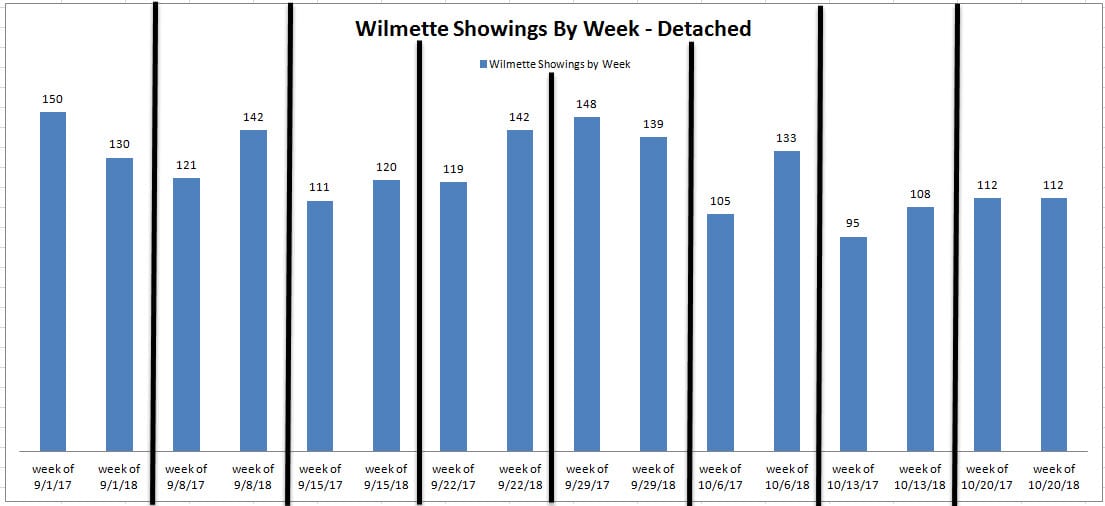
First, showing activity – it is essentially even with last year and, in some weeks, up over 2017 numbers.  So buyers are out shopping in equal numbers to one year ago!  That is good news.

Wilmette-showings-by-weekNext, I looked at Under Contract activity.  After all, if buyers are looking but not buying – that doesn’t help the market at all. . . 
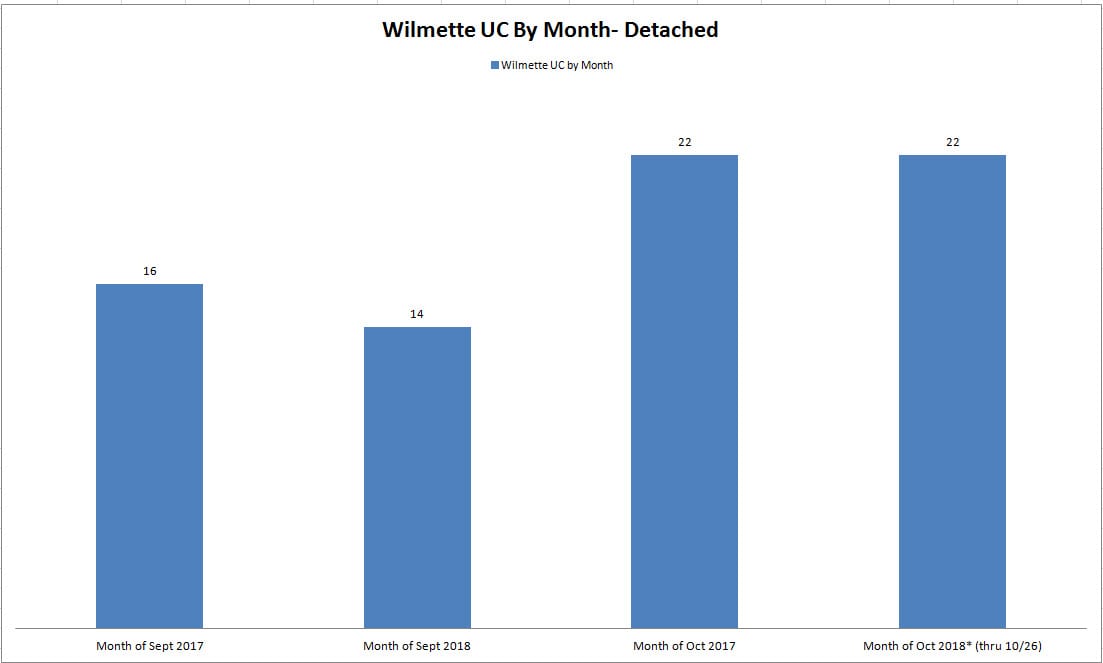
But under contract activity is also about even with 2017, so buyers seem to be buying as many Wilmette homes now as they did in the third quarter of last year.

Wilmette Under Contract Activity By Month

Wilmette Under Contract Activity By Month

 Wilmette Under Contract Activity By Month

Wilmette Under Contract Activity By Month

Since showings and under contract activity are just as strong in 2018 as in 2017, I wanted to check one last metric – inventory levels.  And those have risen in 2018 v. 2017 so there are more homes on the market.  The months supply of home has increased from 5.1 months a year ago to 6.1 months.  In raw numbers, 158 detached homes were for sale in Wilmette on 10/27/17 and 179 are on the market right now (10/27/18), one year later.  So with more inventory and stable showings/under contracts, it can feel like activity has slowed. . .

Months Supply Wilmette October 2018

Months Supply Wilmette October 2018

While a greater supply can lessen demand and push down price – there is more good news in that prices have held firm and have actually seen improvement in the last several months.

Wilmette Average Sales Prices October 2018

Wilmette Average Sales Prices October 2018

In sum, the Wilmette market is strong!  It’s still a great time to buy and sell!

For sellers, make sure your home is prepped to sell and priced competitively to contend with increased competition. 

For buyers, even though interest rates are rising, they are still at historically low levels and with a strong economy, it’s still a great time to invest in your future by purchasing a home.

Whether buying or selling, I’m happy to help.  Please call me at 847-778-0540 or email me at Lisa@LisaFinks.com.

For details about my exclusive Strategic Seller Program, click here.

For details about the comprehensive services offered to buyers, click here.

Filed Under: Market Stats

  • « Go to Previous Page
  • Page 1
  • Page 2
  • Page 3
  • Page 4
  • Page 5
  • Interim pages omitted …
  • Page 9
  • Go to Next Page »

Work with us

Merging their individual knowledge, resources and expertise, Lisa Finks, Lourdes Arencibia & Carolyn Duris offer their real estate clients superior advocacy skills and exceptional results.

Contact Us

Newsletter

For market updates, community information and exclusive news, sign up for our monthly newsletter.

Join Now

The Blog

Recent News

  • DIY Home Projects to Help the Time Fly During the Pandemic
  • When Do New Listings Come on the Market in Chicago’s North Shore
  • Thinking of Downsizing? Don’t Make One of These 5 Common Mistakes
  • Preparing the Most Competitive Offer You Can

Lisa Finks, Lourdes Arencibia & Carolyn Duris, 565 Lincoln Ave, Winnetka, IL (847) 778-0540 info@northshoreaddress.com

Compass Real Estate

privacy policy

Realtor logos

email disclaimer

© 2019 Lisa Finks, Compass Real Estate. All Rights Reserved.

LISA FINKS, LOURDES ARENCIBIA & CAROLYN DURIS ARE REAL ESTATE AGENTS AFFILIATED WITH COMPASS, A LICENSED REAL ESTATE BROKER WITH A PRINCIPAL OFFICE IN CHICAGO, IL, AND ABIDE BY ALL APPLICABLE EQUAL HOUSING OPPORTUNITY LAWS. ALL MATERIAL PRESENTED HEREIN IS INTENDED FOR INFORMATIONAL PURPOSES ONLY. INFORMATION IS COMPILED FROM SOURCES DEEMED RELIABLE BUT IS SUBJECT TO ERRORS, OMISSIONS, CHANGES IN PRICE, CONDITION, SALE, OR WITHDRAWAL WITHOUT NOTICE. NO STATEMENT IS MADE AS TO ACCURACY OF ANY DESCRIPTION. ALL MEASUREMENTS AND SQUARE FOOTAGES ARE APPROXIMATE. THIS IS NOT INTENDED TO SOLICIT PROPERTY ALREADY LISTED. NOTHING HEREIN SHALL BE CONSTRUED AS LEGAL, ACCOUNTING OR OTHER PROFESSIONAL ADVICE OUTSIDE THE REALM OF REAL ESTATE BROKERAGE.